Story time is one of the few parts of the school day that every child looks forward to. It’s also one of the most flexible: a story can settle a class after lunch, introduce a topic, model how to treat a new classmate, or give a reluctant writer something to argue with.
KidsGotWings was designed for families, but teachers of young children have the same need parents do — the right story for this group, today. This post collects ideas for using it in a classroom, with example prompts, and some ground rules about pupils’ privacy that we’d ask you to read first.
First: keep pupils’ details out of it
At home, a parent decides what to share about their own child. In a classroom that decision isn’t yours alone, so we’d suggest a simple rule: don’t enter personal information about pupils.
- Use a class mascot or made-up characters rather than real children. A story about Pebble the class tortoise belongs to everyone.
- If you use names at all, use first names only — and only where your school’s policies and families’ permissions allow it. Never add surnames, addresses, birthdays or anything about a child’s health or home life.
- Don’t record or upload pupils’ voices. Voice cloning is for consenting adults; use a stock storyteller, or your own voice if you choose to add it.
- Keep class stories private unless there’s nothing in them that identifies your school or pupils.
- Follow your school’s rules on classroom technology and AI tools. They come first.
The things typed into a story are sent to the AI services that write and illustrate it, which is another reason to keep real children’s details out. There’s more on how this works in How we keep stories safe for kids.
A simple classroom set-up
One way to set it up
| Account | One teacher account; the teacher creates and checks every story |
|---|---|
| Characters | A class mascot and a small made-up cast, typed in as custom characters |
| Reading level | Ages 2–4, 5–7 or 8–10 — matched to the group, not the oldest child |
| Narration | A stock storyteller, or read it aloud yourself |
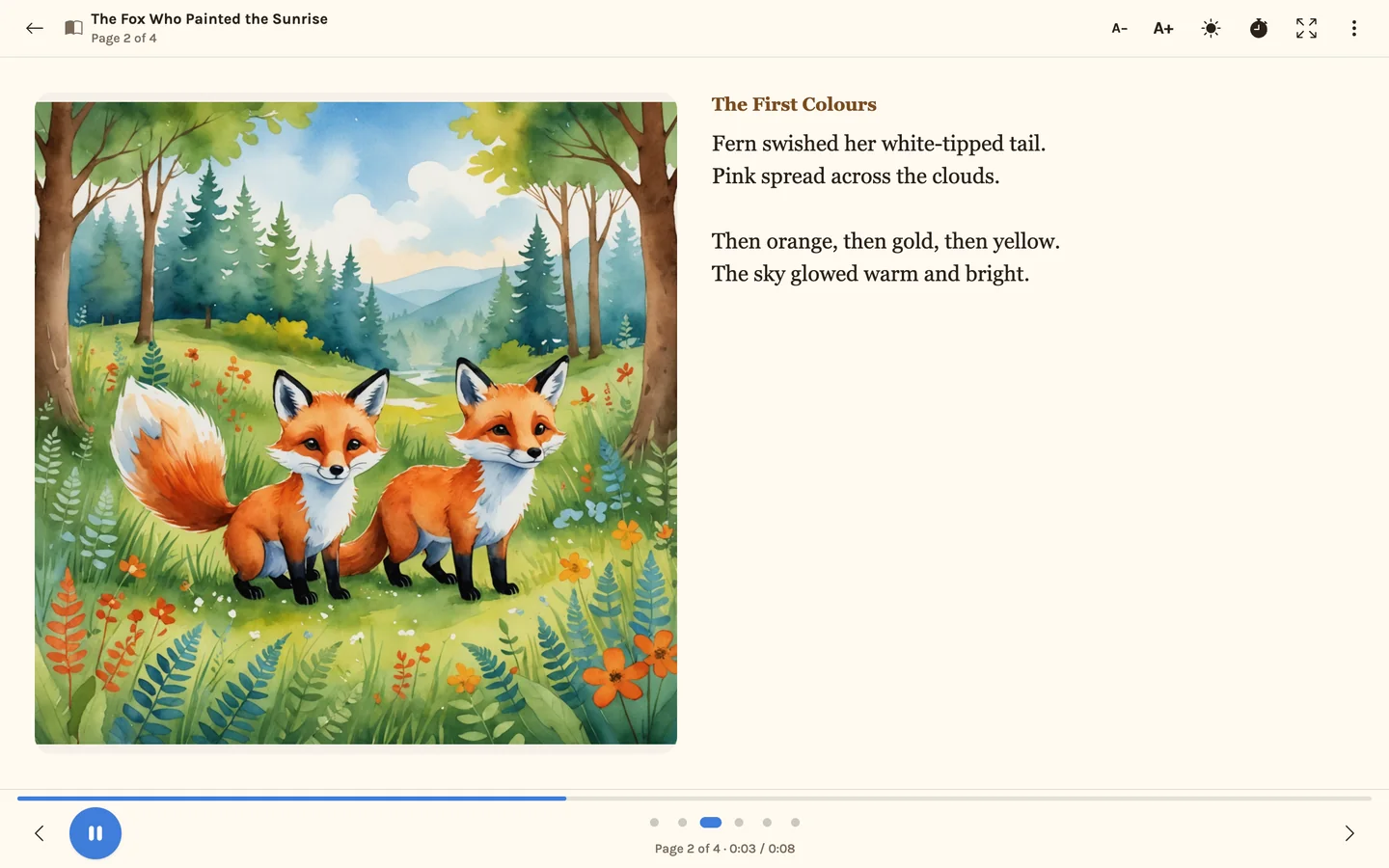
| Display | The reader on the classroom screen, one page at a time |
| Sharing | Private |
Always read a story through before showing it to the class. Stories are written by AI, each idea is checked for suitability first, and every section can be edited — but you’re the one who knows your pupils.
Eight ways to use it
1. The class mascot series
Give the class a recurring character and let its adventures follow the term. Pebble visits the pond in the week you study pond life; Pebble is nervous before the class assembly. A sequel continues an existing story, so the series can grow week by week.
2. The class writes the prompt
Put the four questions on the board — who, where, what small problem, how does it end — and take suggestions. Vote. Type the winning prompt together and create the story while the class does something else; read it at the end of the day. Children are remarkably invested in a story they ordered.
3. Topic openers
A short story can introduce a topic’s vocabulary before the lesson proper: the water cycle told by a raindrop, a seed’s first spring, a letter’s journey through the post. Treat the story as a hook, not a source: check any facts against your teaching materials, since a storyteller’s priority is the story.
4. Rehearsing routines and firsts
Fire drills, a visit from the school photographer, a trip on a coach, a new child joining mid-term. A story in which a character goes through the same thing, step by step, lets a class talk about it beforehand. Many teachers already use simple narrative walk-throughs like this; a custom story lets you match the details to your own setting.
5. Feelings and friendship
Falling out at playtime, including someone new, losing a game. Use the lesson option — “taking turns”, “saying sorry” — with animal characters, so nobody in the room feels singled out. There are twelve ready-made prompts in Stories that teach.
6. Same story, three levels
Create the same story at different reading levels for different groups. Everyone discusses the same plot; each group reads a version that suits them.
7. Language learners
Stories can be written and narrated in 14 languages. A story in a new arrival’s home language is a small welcome; the same story in the classroom language gives them a bridge. For language lessons, repetitive stories with counting, colors and animals work well — see Bilingual bedtime.
8. Story as a writing prompt
Read a story up to its last section, close it, and ask: what happens next? Or change one thing — the setting, the ending, the art style — and compare. Older pupils can critique the story: which sentence would they cut? What did the picture get wrong?
Twelve classroom prompts
- Pebble the class tortoise is worried about being too slow for sports day. The class invents a race that suits everyone. Lesson: everyone has something they are good at.
- A raindrop falls from a cloud, runs down a hill into a river, reaches the sea, and rises back up to the cloud to tell her friends about it.
- A new penguin joins the colony halfway through winter and doesn’t know the games. One small penguin shows her around. Lesson: welcoming someone new.
- The classroom pencils hold a meeting at night because they are tired of being left on the floor. Lesson: looking after our things.
- A seed sleeps under the snow all winter, wakes in spring, and is surprised to discover what it has become.
- Two squirrels both want to be line leader. They work out a fair way to decide. Lesson: taking turns.
- A bus full of animals goes on a school trip to the farm. Each animal has one job to remember. Everyone gets home safely.
- A little robot starts at a school for children and has to learn how break time works.
- The fire bell rings at Hedgehog School. Everyone remembers what to do: stop, line up, walk, wait. It was only a practice, and the teacher is proud.
- A letter travels from a child’s hand to the postbox, the sorting office, a van and a doormat far away.
- A caterpillar is asked what she wants to be when she grows up, and has no idea how good the answer is going to be.
- The class goldfish tells the story of the school day from inside his bowl.
An example opening
Here’s how the fire-drill prompt might begin. We wrote this excerpt ourselves as an illustration of the calm, step-by-step tone that suits a routine story:
Example excerpt · The Bell at Hedgehog School
It was an ordinary Tuesday at Hedgehog School. Hazel was painting. Bramble was counting conkers. And then — brrrring! — the bell rang.
It was a loud bell. But the hedgehogs knew just what it meant, because Miss Thistle had shown them.
First, they stopped. Paintbrushes down. Then they lined up at the door, one behind the other, quiet as moss.
Practical notes
- Make stories ahead of time. Writing and illustrating takes a few minutes, and narration and film take longer. Create tomorrow’s story today.
- Mind the daily limits. A free account has daily limits on stories, pictures, narrations and films. Plan for one or two stories a day rather than one per pupil.
- Edit freely. Change a word the class doesn’t know yet, or add one you’re teaching this week. Redraw a picture that distracts.
- Print a copy for the book corner. Any story can be printed or saved as a PDF — see From screen to keepsake. A class-made book is a popular choice at reading time.
- Download the film for a story you’ll reuse, so you aren’t relying on the internet connection on the day.
A closing thought
None of this replaces the books on your shelves or the stories you tell from memory. It adds one thing: a story that didn’t exist this morning, about exactly what your class needs today. Used a little, and checked by a teacher, that’s a useful thing to have in the cupboard.
Make tonight’s story
Describe it in a sentence, or pick your family as the characters. It’s free to start, and private unless you choose to share.
Create your first story