A bedtime story starts with a sentence. You type what you’d like tonight’s story to be about, and KidsGotWings writes it in sections, paints a picture for each one and reads it aloud. The sentence you type is called the prompt — and a little care with it makes a big difference to the story you get back.
This guide covers a simple way to build a prompt, the common pitfalls, and 25 prompts you can copy and change to suit your family.
The four-part prompt
You don’t need to write the story yourself. You only need to give it a shape. Most good bedtime prompts answer four small questions:
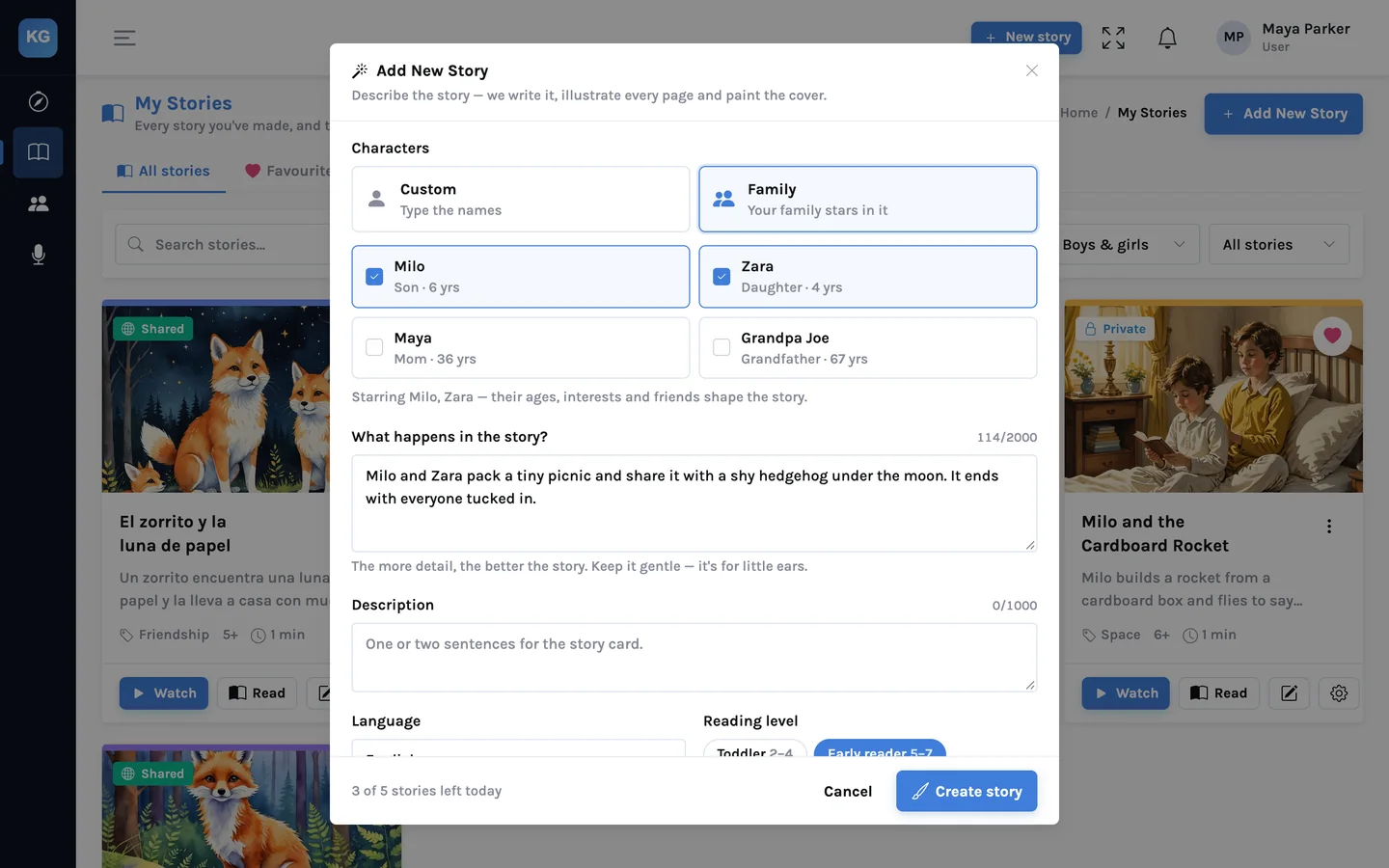
- Who is it about? One or two characters is plenty. If you pick your own family members as the characters, you can skip this part — the story already knows their names, ages and interests.
- Where are they? A place a child can picture: the garden at night, a lighthouse, the top bunk, Grandma’s kitchen.
- What small thing happens? A lost mitten, a sound in the attic, a friend who needs help. Small problems make the best bedtime stories.
- How does it end? For bedtime, ask for a calm ending: home, warm, safe, sleepy.
Put together, that might read:
- A little hedgehog who can’t sleep goes for a walk through the garden at night and helps a snail find its way home. It ends with the hedgehog curled up in a pile of leaves, fast asleep.
That’s two sentences. A prompt can be up to 2,000 characters, but two or three sentences is usually all a story needs. Leave room for a surprise.
Small problems, soft landings
A bedtime story is not an action film. The stories children ask for again tend to have one gentle problem and a reassuring ending. A few things that help:
- Keep the stakes child-sized. “The moon has gone missing” is a wonderful problem. “The world is ending” is not a bedtime problem.
- Say how it should feel. Words like cozy, gentle, funny or quiet steer the whole story.
- Ask for the ending you want. “It ends with everyone tucked in” is the most useful sentence you can add.
- One idea per story. If you have three ideas, that’s three nights sorted.
Add the details only you know
The most loved stories are full of things that are true about your child: the name of the cuddly rabbit, the street you live on, the fact that they will only eat the red jelly beans. You can type these into the prompt, or — better — add your family once in My Family and pick them as the characters. Then every story can use their names, ages and interests without you typing them again.
Let the options do the rest
Some things don’t need to go in the prompt at all, because the story form has an option for each of them:
- Language — the story and its narration can be in any of 14 languages.
- Moral or lesson — a value you’d like the story to carry, such as sharing or courage.
- Art style — watercolor, cartoon, storybook, 3D, paper cut-out, pencil sketch or anime.
- Reading level — ages 2–4, 5–7 or 8–10, which changes the length of sentences and the words used.
Keeping these out of the prompt leaves it free for the part only you can supply: the idea. If you’re stuck, the idea starters next to the prompt box will give you a first line to change.
25 prompts to borrow
Copy any of these and swap in your own names, animals and places.
Cozy and sleepy
- A baby owl is too excited to sleep on her first night in a new nest. Her dad shows her how to count the stars until her eyes close.
- The last train of the night carries sleepy animals home, one stop at a time. The final passenger is a very small mouse who lives under the station clock.
- A cloud that is tired of raining floats down to rest on a hill and becomes a warm, soft bed for a family of rabbits.
- A lighthouse keeper’s cat makes sure every boat is safely home before she curls up by the lamp.
- The moon is looking for someone to say goodnight to, and finds a child at a window who has been waiting to say it back.
Adventures that end in bed
- Two brave explorers sail a laundry basket across the living-room sea to Sofa Island, and are home in time for hot milk.
- A girl finds a tiny door behind the bookshelf. Behind it is a library for mice, and she is allowed to borrow one very small book.
- A boy and his cardboard rocket visit the moon to return a button that fell off its coat. They are back before the bathwater gets cold.
- A snow fox follows the northern lights across the ice and discovers they lead back to her own den.
- A paper boat sails down a rain puddle river, past the garden gnome and under the gate, and is carried home by a friendly duck.
Starring your family
- Our children discover that the family dog can talk, but only after everyone else is asleep, and only about snacks.
- A treasure map appears in the cereal box. It leads around our own house and ends at the children’s beds, where the treasure is a goodnight hug.
- Grandpa’s old fishing hat turns out to grant very small wishes. The children use the last one to wish Grandpa sweet dreams.
- The children shrink to the size of ladybugs and explore the back garden, riding home on the cat before bedtime.
- Our family opens a bakery for forest animals for one night only. The hedgehogs want jam tarts; the bear wants everything.
Feelings and firsts
- A little dragon is nervous about her first day at flying school. She finds a friend who is nervous too, and they practice together.
- A young bear is cross that the new baby cub gets all the attention, until he discovers he is the only one who can make the baby laugh.
- A bunny visits the dentist for the first time. The dentist is a kind giraffe who counts every tooth and gives her a sticker.
- A small penguin is afraid of the dark until an older penguin shows him that the dark is where the stars keep their light.
- A squirrel moves to a new tree and misses her old one. By the end of the day she has met the neighbors and chosen her favorite branch.
Just silly
- A cow decides she would rather be a ballerina. The other cows laugh, until the farm holds a talent show.
- A sock goes on a journey to find its missing partner, which has been living happily behind the washing machine.
- A dinosaur tries to hide during hide-and-seek. He is extremely bad at it. Everyone pretends not to see him.
- A grumpy troll opens a lemonade stand under his bridge and accidentally becomes the most popular troll in town.
- The vegetables in the fridge hold a midnight parade. The broccoli is the conductor. A very sleepy pea just wants to go to bed.
What one prompt turns into
Here is the hedgehog prompt from the top of this guide, and the kind of opening it produces. We wrote this excerpt ourselves to show the tone to aim for:
Example excerpt · The Hedgehog Who Couldn’t Sleep
Hazel the hedgehog had tried everything. She had counted acorns. She had fluffed her leaves. She had even closed one eye at a time, very slowly. But sleep would not come.
So Hazel put on her smallest scarf and went for a walk. The garden at night was silver and still. Somewhere near the flowerpots, a very small voice said, “Excuse me. I seem to have lost my house.”
It was a snail. And as everyone knows, a snail who has lost his house has not looked behind him.
If the first draft isn’t quite right
You are not stuck with the first version. Every story is made of sections, and each one can be changed on its own:
- Edit the words of any section directly — handy for fixing a name or adding a family joke.
- Ask for a rewrite of one section with a short note, such as “make this part funnier”.
- Redraw a picture you don’t love: write a note about what you’d like to see instead, then press Regenerate Image. Regenerate Text does the same for the words.
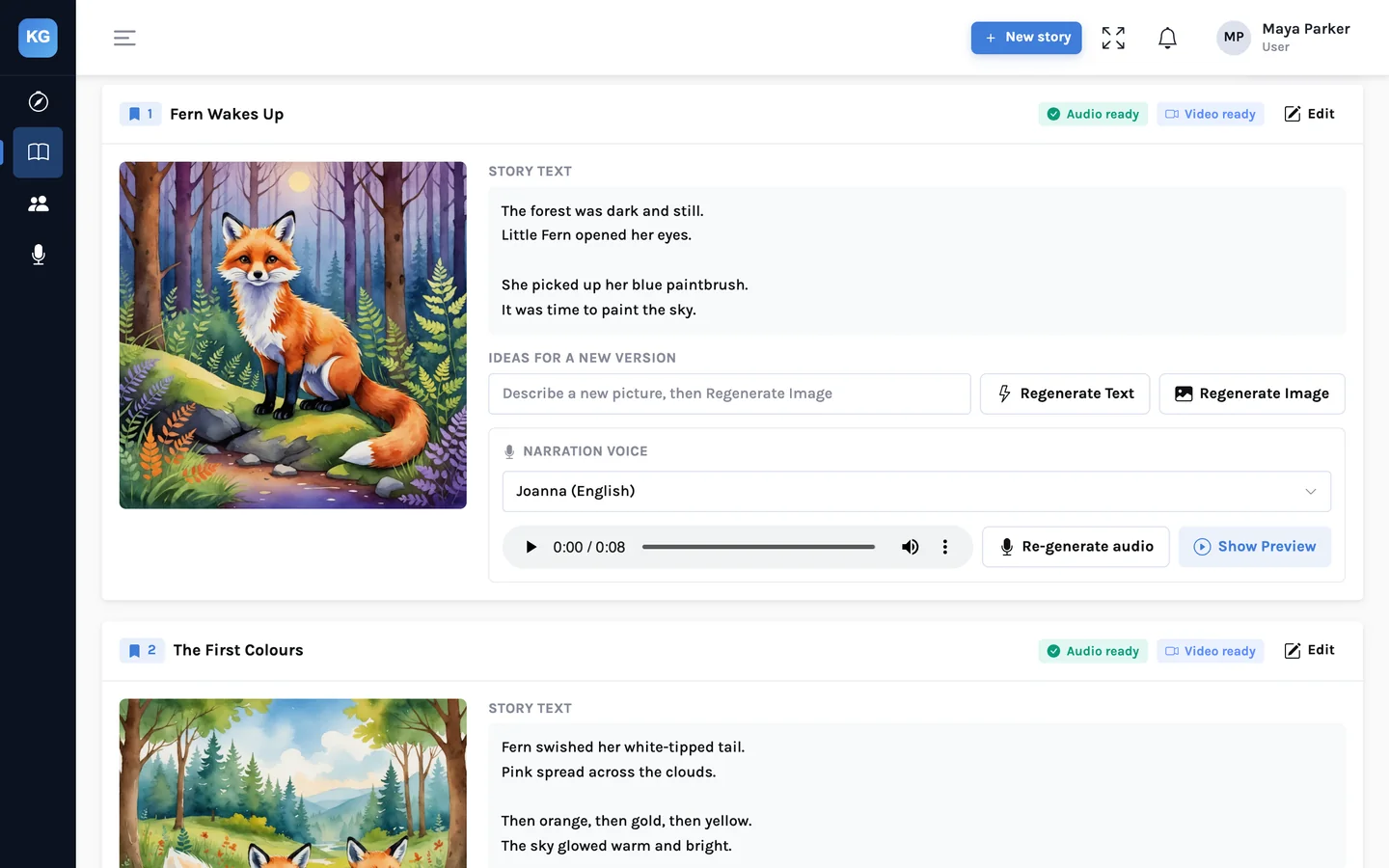
If you change a section’s words after it has been narrated, narrate that section again so the voice matches the page.
A quick checklist
- One or two characters, one place, one small problem.
- A word for the mood: cozy, gentle, funny.
- A calm ending, spelled out.
- Details only your family would know.
- Language, lesson, art style and reading level set in the options, not the prompt.
Then press create, and go and find the pajamas. For the next step, see Make your child the hero.
Make tonight’s story
Describe it in a sentence, or pick your family as the characters. It’s free to start, and private unless you choose to share.
Create your first story