KidsGotWings makes stories for children, about children, sometimes in a parent’s own voice. Each of those is a reason to be careful. This post sets out, as plainly as we can, what the product does to keep stories appropriate and families in control — and where the limits of that are.
We’ve tried to avoid promises we can’t keep. You won’t find the words “100% safe” here, because no system that uses AI can honestly say that. What you’ll find is a description of how it actually works.
Private by default
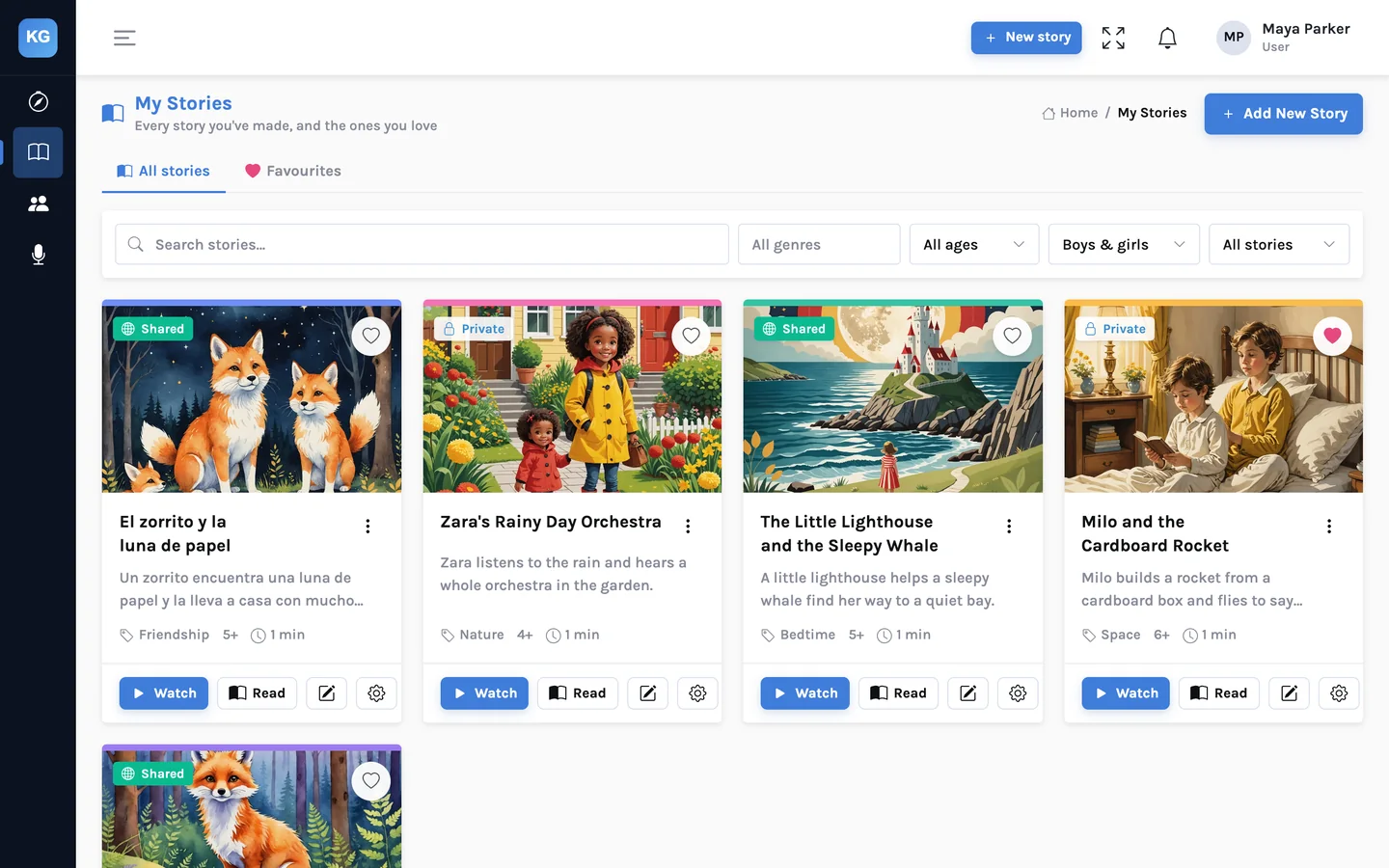
When you create a story, it’s yours. Nobody else can see it. It only becomes public if you switch on Share in Discover for that story, and you can switch it off again.
- Your stories, family and voices are visible only to you when you’re signed in.
- A shared story appears in the Discover library and can be opened by anyone with its link.
- Sharing is per story. Sharing one doesn’t share the others, and your My Family profiles are not published — though a shared story will of course contain whatever names and details the story itself uses.
Checking the idea before a story is written
Every story idea is checked for suitability before anything is written. If a title or prompt isn’t appropriate for a children’s story, no story is created, and you’re asked to try a different idea.
This check is automatic. It will occasionally be too cautious and turn down something harmless; rewording the idea usually sorts that out. It may also, rarely, let through something you’d rather it hadn’t — which is why the next section matters.
You’re the editor
Stories and pictures are generated by AI. AI is good at this, and it also makes mistakes: a sentence that doesn’t quite make sense, a picture with an odd detail, a tone that’s a little off for your child. So:
- Read a story yourself before you read it to your child. It takes a minute or two.
- Change anything. Every section’s words can be edited or rewritten, and every picture can be redrawn.
- Delete what you don’t want. Deleting a story removes its text, pictures, narration and film.
We’d say the same about any new book: a grown-up looks first.
The Discover library and reporting
Discover is where families can choose to share stories with everyone. Because anyone can browse it, it has its own safeguards:
- Only stories a family chose to share appear there.
- Every shared story has a report option. You can tell us a story is inappropriate, scary, a copyright problem, or that it contains personal information — or describe another concern in your own words.
- Reports go to our moderators, who can dismiss a report or remove the story from the library.
- Anyone can report, signed in or not.
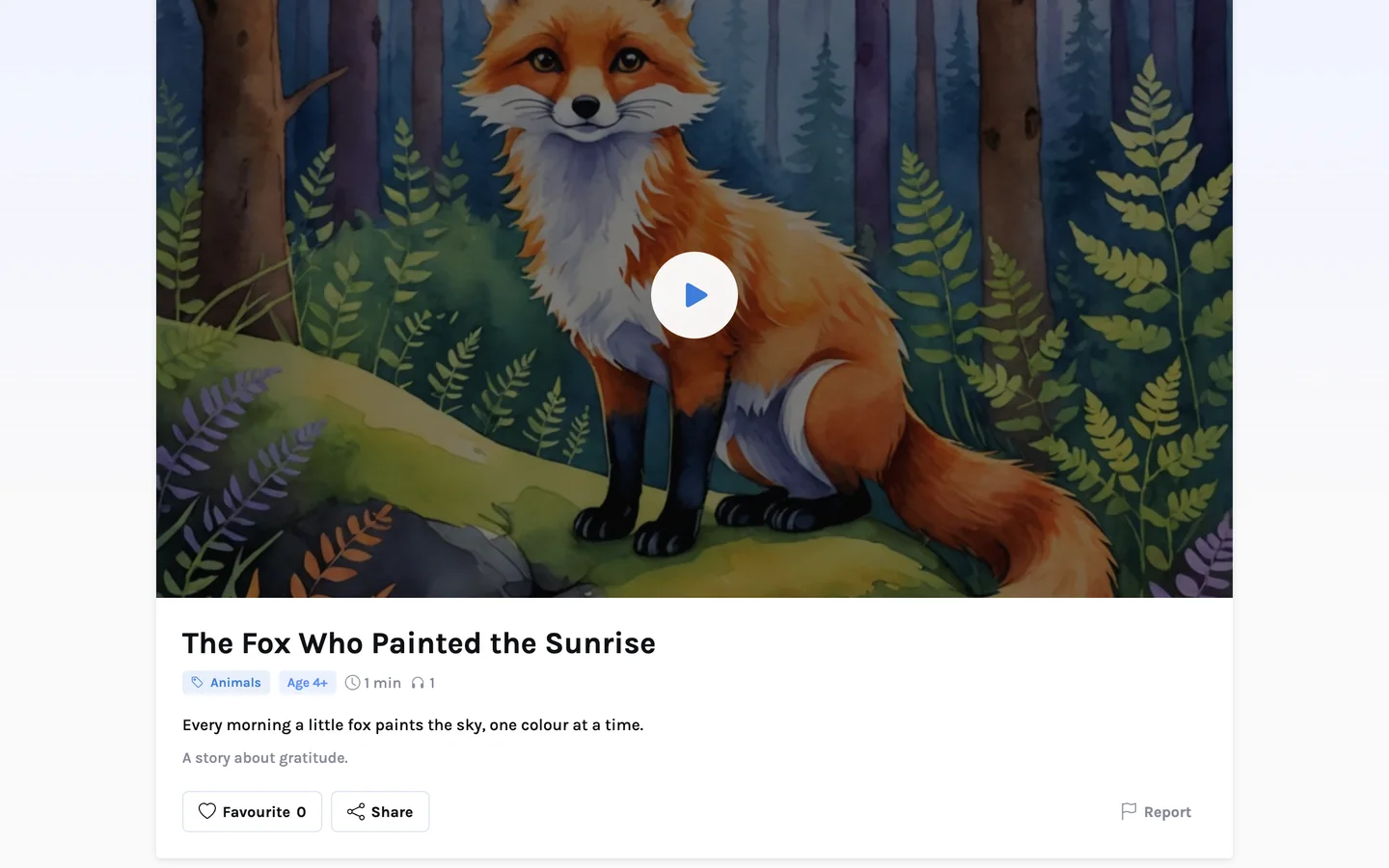
If you see something in Discover that shouldn’t be there, please report it. It’s the fastest way for us to find out.
Voices and consent
A parent or grandparent can record a short sample and have stories narrated in a voice modeled on theirs. It’s a lovely feature and a sensitive one, so it comes with rules:
- It’s opt-in. No voice is created unless someone chooses to add one.
- Consent is asked for explicitly before a voice is created: the voice must be your own, or the person it belongs to must have agreed.
- A family’s voices stay with that family. They aren’t offered to other accounts.
- A voice can be removed at any time, which deletes it at our voice provider.
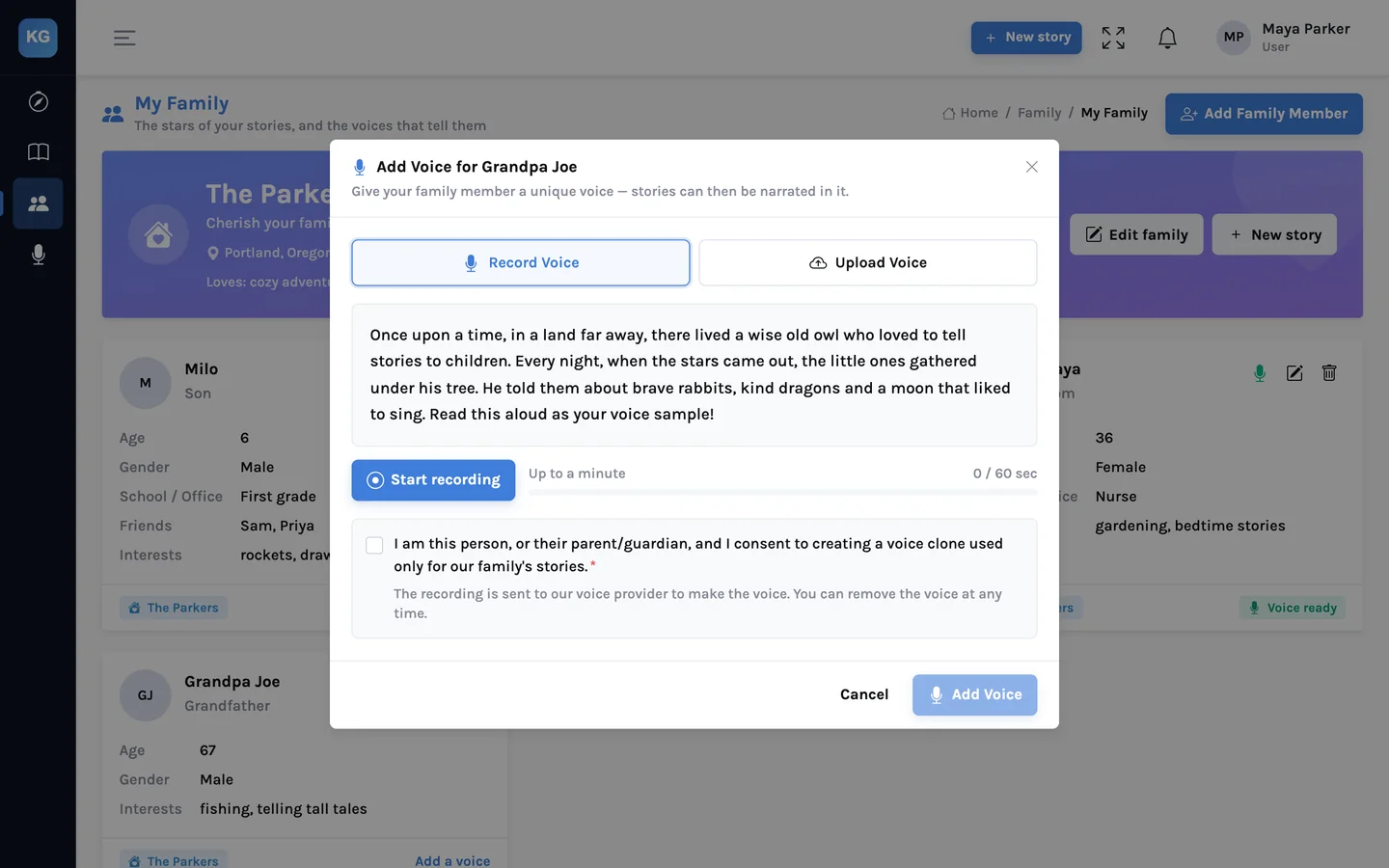
There’s a full walkthrough in Read to them in your own voice from anywhere.
Your data: see it, take it, delete it
The details you add — your family, your children’s names, ages and interests — are there to make stories personal. You stay in charge of them:
- Most details are optional. A story needs very little. Add what you’re comfortable with.
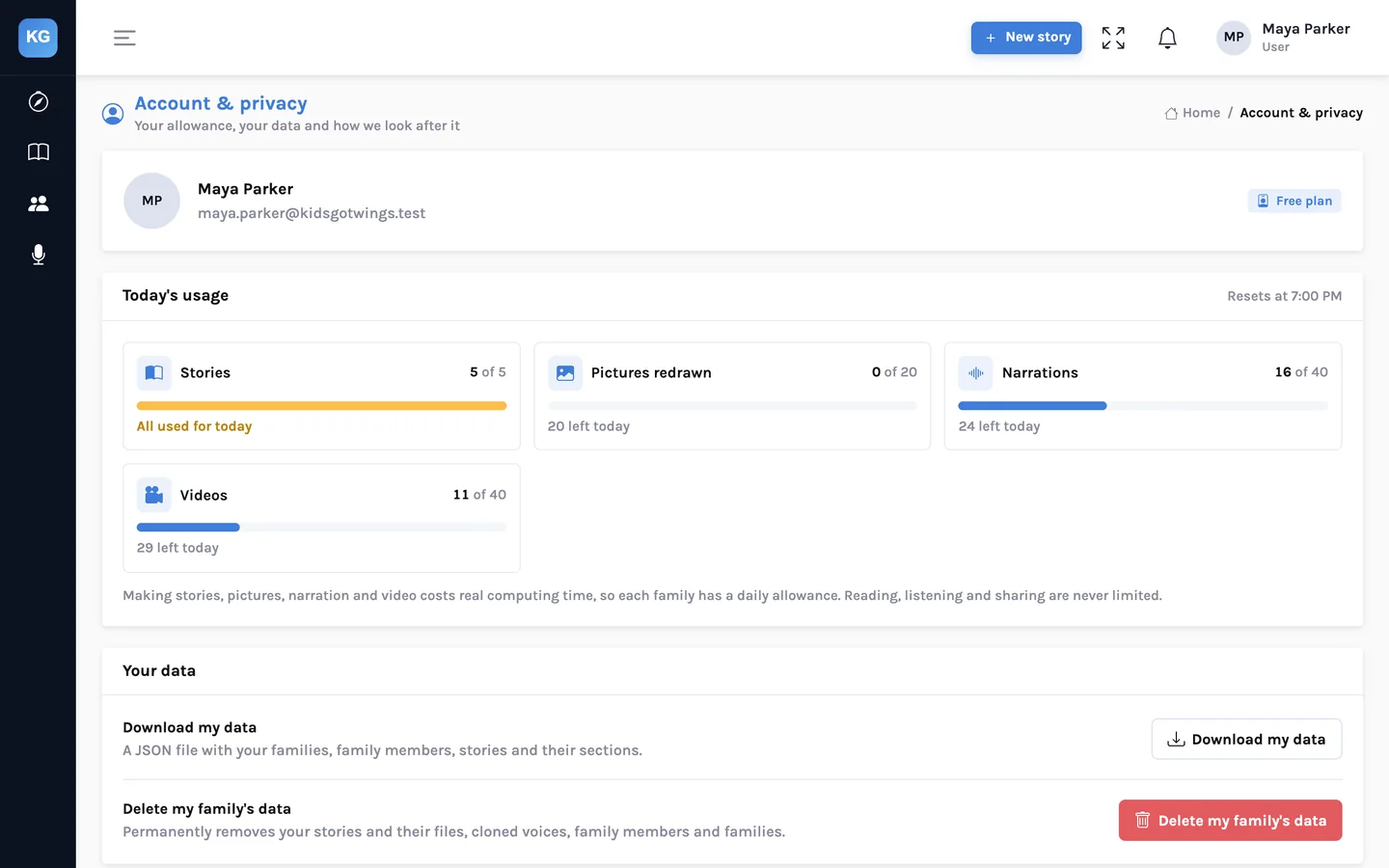
- Download your data. From your account page you can download what you’ve made: your families, family members, stories and their sections.
- Delete your data. From the same page you can delete your stories and their files, your cloned voices, your family members and your families. You’re asked to confirm first, because it can’t be undone.
Who else is involved
We don’t build every part of this ourselves, and you should know who does what:
- Amazon Web Services — hosts the service and stores your stories’ files; its AI services write the story text, draw the illustrations and narrate in stock voices, from the idea and details you provide.
- OpenAI — may also be used to write story text and draw illustrations.
- ElevenLabs — when family voices are switched on, creates a family voice from the sample you record and narrates in it.
- Google — only if you choose to sign in with Google.
That means the things you type into a story — including names and details about your family, if you use them — are sent to these providers so the story can be made. It’s one more reason to add only what you’re comfortable with. The privacy page goes through this in more detail.
No ads, and limits on purpose
No advertising
There are no ads in KidsGotWings — not in the app, not in the stories, not in the library.
Daily limits
KidsGotWings is free to start, with daily limits on how many stories, pictures, narrations, films and voices an account can create. Your account page shows what you’ve used and when the limits reset. The limits keep the service fair and available for everyone; they also happen to be a gentle reminder that one or two stories a night is plenty.
Made for grown-ups to use with children
Accounts are for adults: parents, carers, grandparents, teachers. Children enjoy the stories; a grown-up creates them, checks them and decides what’s shared. The reader is designed to be used together, the way a book is.
What we can’t promise
In the spirit of being straight with you:
- AI makes mistakes. Checks reduce the chance of something unsuitable; they can’t remove it. Please read stories first.
- Pictures can be inconsistent. A character may look different from one page to the next. Redrawing helps.
- A shared story is public. Once someone has opened or downloaded it, switching sharing off can’t take that back.
- We’re still improving. Reporting, moderation and the safety checks are things we expect to keep working on.
Tell us
If something isn’t right — a story that shouldn’t have been written, a shared story that shouldn’t be public, a worry about your data — use the report option on the story, and see the child safety page for how the pieces fit together. We’d rather hear about a problem than not.
Make tonight’s story
Describe it in a sentence, or pick your family as the characters. It’s free to start, and private unless you choose to share.
Create your first story