In many homes, bedtime happens in more than one language. A grandmother’s lullabies are in one, school is in another, and the children move between the two without thinking about it. In other homes a second language is something the family is learning together, one word at a time.
Either way, stories help. Children pick up language from hearing it used in a context they care about, and few contexts are as inviting as a story about themselves. KidsGotWings can write and narrate a story in any of 14 languages, which makes a few bilingual routines very easy to try.
The 14 languages
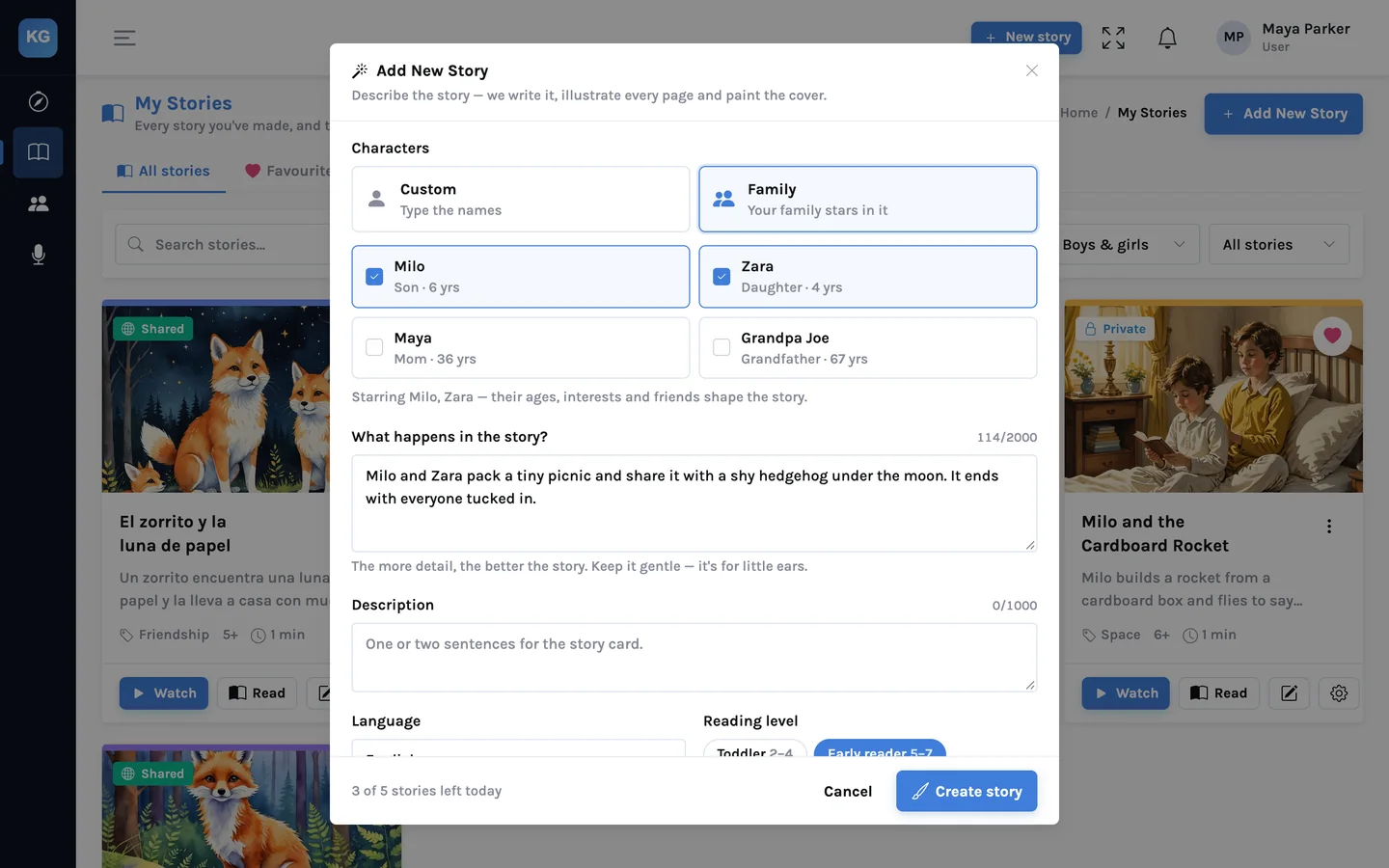
When you create a story you choose its language. The words on the page and the narration are both in that language:
English, Spanish, French, German, Italian, Portuguese, Hindi, Arabic, Chinese, Japanese, Korean, Dutch, Polish and Turkish.
You can write your prompt in whichever language you’re most comfortable typing in; the language option decides what the story is written in. Stories shared in Discover can be filtered by language too, so you can browse what other families have made.
Four routines that work
1. The same story, twice
Create a story in your home language. Then create it again with the same title idea and prompt, but with the second language selected. You now have a pair: read the familiar one first, and the other the next night. Because your child already knows what happens, they can follow the second version by leaning on the pictures and the plot.
The two versions won’t be word-for-word translations — each is written fresh — but the characters and events will match closely if the prompt is specific.
2. Alternate nights
Monday in one language, Tuesday in the other. Predictability matters more than quantity; a short story in the second language three times a week is plenty. Favorite the ones that land so you can find them again.
3. One language per grown-up
Many bilingual families follow a “one person, one language” habit. Stories fit neatly into it: the parent who speaks Spanish reads the Spanish story, the parent who speaks English reads the English one. If a grandparent speaks the heritage language, their stories can be the special ones in that language.
4. The story stays; the reading level drops
For a language your child is still learning, choose a lower reading level than you would in their strongest language. A seven-year-old who reads confidently in English may enjoy a story written for ages 2–4 in French: short sentences, repeated phrases and a clear picture on every page.
A worked example
An example set-up
| Family | Two children, ages 4 and 6; English at school, Spanish with Abuela |
|---|---|
| Prompt | Abuela’s owl knows every lullaby. One night the owl loses her voice, and the children help her find it by singing the lullabies back to her. |
| Story 1 | Language: English · Reading level: ages 5–7 |
| Story 2 | Language: Spanish · Reading level: ages 2–4 |
| Art style | Storybook, for both |
Here is how the same moment might read in each. We wrote these excerpts ourselves as an illustration.
Example excerpt · Abuela’s Owl
On the tallest branch of the lemon tree sat Abuela’s owl. Every night she sang the children to sleep. But tonight, when she opened her beak, nothing came out. Not a hoot. Not a whisper.
“Don’t worry,” said Lucía. “We know all your songs. We’ll sing them to you.”
Example excerpt · El búho de la abuela
En el limonero vive un búho. Es el búho de la abuela. Cada noche, el búho canta.
Pero esta noche, el búho no puede cantar. «No te preocupes», dice Lucía. «Nosotros cantamos para ti.»
The Spanish version is simpler on purpose. Short sentences in the present tense are easy to follow, and easy for a child to repeat.
Prompts that suit two languages
Stories with repetition, counting, colors, animals, food and family words give a learner lots to hold on to.
- A little train stops at five stations. At each one, a different animal gets on and says hello.
- A child helps Grandma cook dinner. They name every vegetable as it goes into the pot.
- A cat looks for her kitten in every room of the house: the kitchen, the bathroom, the bedroom, under the bed.
- A rainbow has lost its colors. A child finds them one by one: a red apple, a yellow sun, a blue door.
- Three friends pack a picnic. Each brings one thing, and they count everything twice.
- A bear says goodnight to everything in the forest, one thing at a time, and then to the moon.
- A child visits cousins in another country and learns what they call their favorite things.
- It is the first day of the week, and a busy mouse has one small job for every day until Sunday.
Reading it together
- Listen first. Play the narration once all the way through, turning the pages together.
- Point at the pictures. Name what you see in the second language. Let your child name things too, in whichever language comes out.
- Repeat one line. Pick a phrase that comes up more than once and say it together each time.
- Don’t test. If your child answers in the other language, they understood. That’s the win.
- Come back to it. Repetition is where language sticks. The same story on several nights is a feature, not a failure of imagination.
Voices and languages
Narration follows the story’s language. You can preview the stock storytellers on the Voices page and pick the one that sounds right to you.
If a family member has added their own voice, you can use it for narration too. How a cloned voice sounds in a language the speaker didn’t record in can vary, so try a short story first. And nothing beats the real thing: if Abuela can read the story aloud herself, in person or on a call, the reader works just as well with the narration switched off.
A few honest notes
- Stories are written by AI. Read a story through before bedtime, especially in a language you speak well — you may want to adjust a phrase to sound more natural for your family. Editing is quick.
- If you don’t speak the language yourself, treat the story as listening practice for both of you, and lean on the narration for pronunciation.
- A story is a supplement. It adds enjoyable exposure to a language; it doesn’t replace conversation, books, or the people in a child’s life who speak it.
If your child has a favorite, keep it going with a sequel in either language — see Sequels: turning one good night into a series. And for the building blocks of a prompt, start with How to write a great bedtime-story prompt.
Make tonight’s story
Describe it in a sentence, or pick your family as the characters. It’s free to start, and private unless you choose to share.
Create your first story